Lime mortars explained: hot lime, NHL and lime putty
Choosing the right lime for conservation work on historic buildings
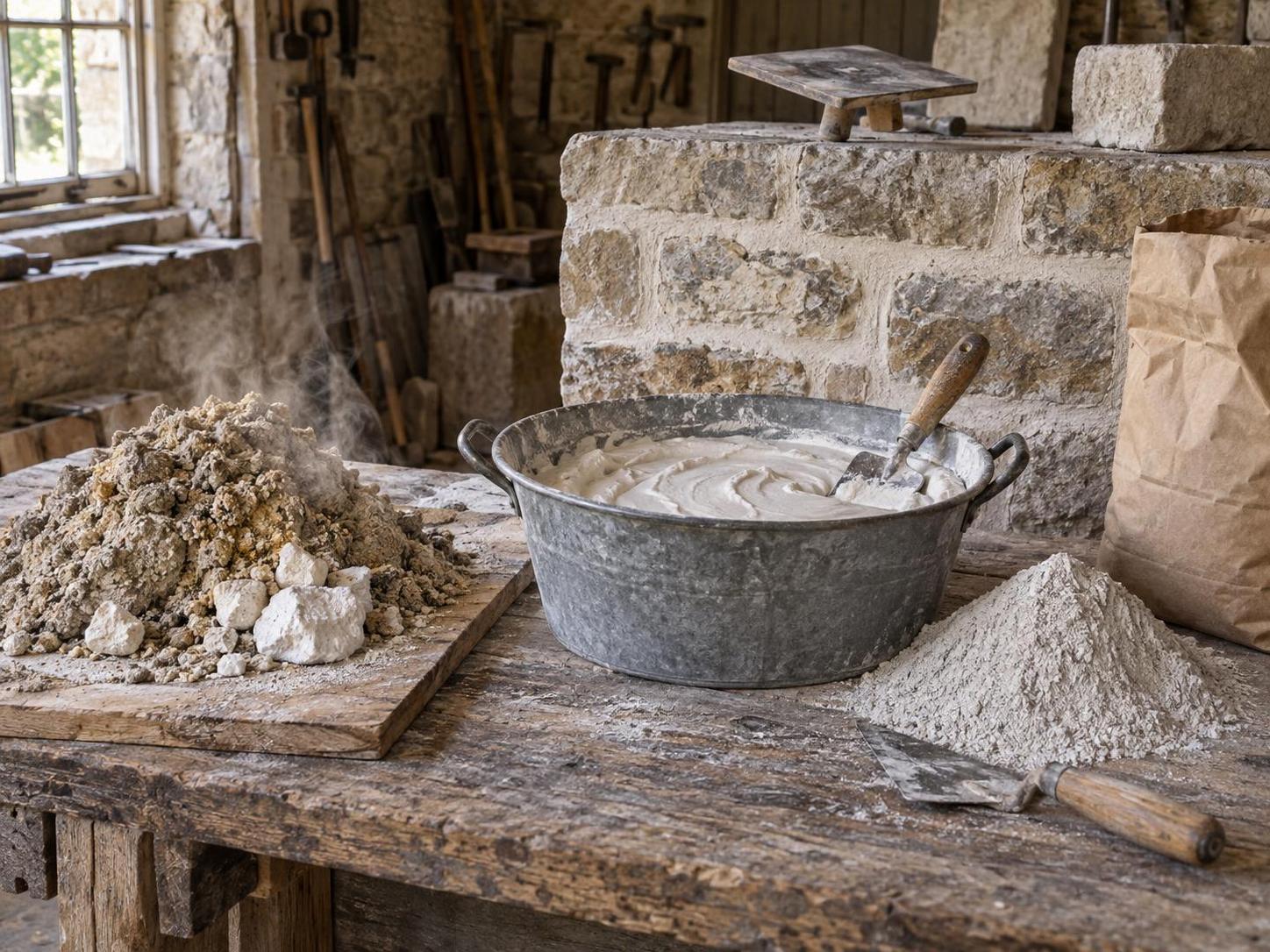
One of the questions we get asked most on site is “what mortar should I use?”. On a historic building the answer is almost always lime, but not all lime mortars are the same. Here is a simple guide to the three we use most in conservation work: hot-mixed lime, natural hydraulic lime (NHL) and slaked lime putty.
Why lime and not cement?
Old buildings were built to breathe. Lime mortar is softer and more porous than the stone or brick around it, so moisture can escape through the joints and the mortar takes the wear instead of the stone. It also allows for a little movement without cracking.
Cement mortar does the opposite. It is hard and traps water in the wall, so the stone around it ends up taking the damage: spalling faces, frost damage and damp inside. The mortar should always be the sacrificial part of the wall, because re-pointing is far cheaper than replacing stone.
Hot-mixed lime
Hot-mixed lime is made by mixing quicklime directly with damp sand. The quicklime reacts with the water, gets very hot and steams, and the mortar is used once it has cooled and been knocked up. This is how most historic mortars were made, which is why you often see small white lumps of lime in old joints.
- Best for: matching original historic mortars, rubble stone walls, bedding and pointing on churches and listed buildings.
- Why we like it: it is rich in lime, sticky and very workable, bonds well to the stone and the lime lumps help it “self-heal” small cracks over time.
- Things to know: quicklime is caustic and reacts violently with water, so it needs experience, goggles, gloves and care on site.
Natural hydraulic lime (NHL)
NHL is made by burning limestone that naturally contains clay and silica. This gives it a “hydraulic” set: it starts to harden by reacting with water, as well as slowly hardening in the air. It comes as a bagged powder and is graded by strength:
- NHL 2 – the weakest and most breathable, for soft stone, soft brick and internal work.
- NHL 3.5 – the all-rounder, used for most general pointing and building.
- NHL 5 – the strongest, for very exposed work like copings, chimneys, paving and walls below ground level.
NHL sets more reliably in wet or cold weather than non-hydraulic lime, which makes it practical on many jobs. The rule is to always use the weakest grade the job allows, because a mortar that is stronger than the stone works against it.
Slaked lime (lime putty)
Lime putty is non-hydraulic lime made by slaking quicklime in plenty of water and leaving it to mature, traditionally for months. It becomes a smooth, creamy putty that is then mixed with sand. It has no hydraulic set at all and hardens slowly by taking carbon dioxide back from the air.
- Best for: soft stone and brick, fine joints on ashlar, delicate repairs, lime plaster and limewash.
- Why we like it: it is the softest and most breathable lime mortar, and lovely to work with.
- Things to know: it sets slowly, so it needs protecting from frost, rain and drying out too quickly, and isn’t suited to very wet or exposed places.
At a glance
| Hot-mixed lime | NHL | Lime putty | |
|---|---|---|---|
| How it sets | Mostly in the air (can be hydraulic, depending on the quicklime) | With water and air | In the air only |
| Strength | Soft to moderate | Moderate to strong (by grade) | Softest |
| Breathability | Very good | Good (less at NHL 5) | Excellent |
| Good for | Matching historic mortars, rubble walls | General pointing, exposed work | Soft stone, fine joints, plaster, limewash |
Choosing the right one
There is no single “best” lime. We look at the stone or brick, how exposed the wall is, the original mortar and the time of year, and we match the colour and texture with the right sand. Whichever lime we use, the work is done the same careful way: joints raked out by hand, the wall dampened first, and the new mortar protected with hessian and kept misted while it cures. We don’t lay lime mortar in frost or when it drops below about 5°C.
If you are not sure what your building needs, get in touch. We are happy to come and have a look and give honest advice.
Need re-pointing or repairs on a historic building? We offer free advice and no obligation quotations across the UK.
Get a free quoteMore from the blog
- Staves Stonemasonry 2026 New Year, New Projects · 8 January 2026
- Stanton Lacy Church · 30 January 2025
- Stonemason Shropshire · 19 November 2024